







In the real estate market, an opportunity can be attractive because of its location, financial prospects, or ownership structure. However, there is an element that deserves just as much attention as the numbers: the way people and organizations conduct their business.
Work ethics is not limited to following rules or using correct corporate rhetoric. It is reflected in the quality of the information shared, the clarity with which risks are explained, compliance with commitments, and the willingness to communicate both the progress and the difficulties of a project.
For an investor who participates in the Florida real estate market, especially from another country, these practices take on particular importance. The geographical distance makes documentation, communication, and transparency fundamental components of their evaluation process.
1. What does it mean to act ethically in the real estate business?
Professional ethics in real estate consists of developing business activities with honesty, responsibility, transparency, and respect for the commitments undertaken.
In practice, it means presenting realistic information, avoiding statements that could lead to error, explaining the conditions of an operation, and recognizing the limits of what is known about a project.
It also involves distinguishing between a financial projection and an obtained result, between a market expectation and a confirmed fact, or between a business opportunity and an investment that still requires analysis.
Florida law provides specific obligations for licensed real estate professionals. For example, Statute §475.278 establishes duties that may include honest and fair treatment, diligence, fund accounting, and disclosure of certain material facts, depending on the type of brokerage relationship. For its part, §475.25 provides for disciplinary measures against behaviors such as fraud, misrepresentation, concealment, and misleading advertising.
This demonstrates that professional conduct is not a secondary matter: it is part of the responsibilities that govern certain real estate activities.
2. Transparency: information before persuasion
A responsible professional relationship is not built solely by presenting the attractive aspects of an investment. It also requires explaining what may affect the investor's decision.
In a real estate project, transparency should be reflected in aspects such as:
- Structure of participation: who receives the capital, under what legal form and what rights do the investors have.
- Use of resources: what are the destinations planned for the capital contributed.
- Identified risks: market factors, construction, financing, regulation, and execution that could affect the project.
- Costs and compensations: Administrative expenses, fees, commissions and other relevant concepts.
- Timelines and scenarios: estimated schedules, conditions that could modify them, and possible alternatives in the event of delays.
- Follow-up information: advances, relevant changes and documentation available during the development of the investment.
Transparency does not consist in handing over a large number of documents without explanation. It consists in presenting relevant, understandable and sufficiently organized information so that the investor can evaluate it.
3. Ethics also requires talking about the risks
One of the most important signs of professionalism is the willingness to discuss less favorable scenarios.
The U.S. Securities and Exchange Commission (SEC), through Investor.gov, warns that private placements may have limited public information, transfer restrictions, and difficulties in reselling. It also notes that the investor could face the total loss of the committed capital.
This is particularly relevant when a participation in a real estate project is structured as a value or private investment instrument. The legal nature of each transaction must be reviewed individually.
Therefore, a professional presentation must allow you to answer questions such as:
- What could have been different from what was planned?
- What factors can increase costs?
- What happens if the marketing takes longer than expected?
- What conditions can affect the exit of investment?
- What information supports the financial projections?
Talking about risks does not mean disqualifying an opportunity. It means providing elements for the decision to be made with judgment and knowledge of the conditions involved.
4. Conflicts of interest: a necessary conversation
Real estate transactions can involve developers, intermediaries, managers, advisors, promoters, and various suppliers. Each of them may have different functions and compensation schemes.
The existence of economic interests does not in itself imply improper conduct. The problem arises when a relevant relationship is not communicated and may influence the recommendation or the investor’s decision.
The SEC explains that certain intermediaries and advisors subject to its regulations must identify and address conflicts of interest, as well as make complete and fair disclosures when appropriate.
To evaluate an opportunity, it is advisable to ask:
- Who receives fees or commissions for participating in the operation?
- Does the person submitting the project have an economic interest in it as well?
- Are there any commercial relationships between the parties involved?
- How are potential conflicts identified and communicated?
Clarity about these points allows us to better understand how the operation is structured and what interests are involved in it.
5. Communication and discipline: ethics after investing
Professional responsibility does not end when a contract is signed or capital contribution is made. It also manifests itself during the execution of the project.
A well-structured communication process should include:
- Periodic reports: information about the status of the project and its main milestones.
- Relevant updates: communication of changes in budget, schedule, permits, or market conditions.
- Organized documentation: availability of the corresponding documents according to the participation structure.
- Defined channels: identification of the persons responsible for attending to consultations.
- Register of decisions: traceability of important changes and agreements.
The frequency and scope of reporting depend on the contractual documents and the participation model. Not all investments have the same reporting obligations.
What is important is that there be consistency between what is communicated at the beginning and the way the investor is kept informed during the process.
6. How this principle is translated into the approach of ASSETSFC
At ASSETSFC, the proposal for investor accompaniment is structured around strategic knowledge, opportunity assessment, risk analysis, and follow-up tools.
From this perspective, ethics must be reflected in every stage of the process:
- Financial education: explain the nature of participation and the concepts involved in investment.
- Opportunity assessment: study the characteristics of the project before presenting its possibilities.
- Risk analysis: consider variables that may affect the development and the expected results.
- Personalized information: facilitate that each investor understands the relevant conditions for their profile and their objectives.
- Relationship and follow-up: maintain communication and documentation channels in accordance with the structure of each operation.
This approach does not eliminate the risks inherent in the real estate market nor replace independent legal, fiscal or financial review. Its value lies in incorporating analytical and communication criteria that allow the investor to participate with greater knowledge of the operation.
🔍 Strategic Note for the Investor
When evaluating an real estate opportunity, don’t focus exclusively on projected profitability or the location of the asset. Also observe how the organization responds when you ask difficult questions.
A professional conversation should allow you to understand the structure of the investment, the risks, the costs, the responsibilities of each participant, and the available information mechanisms.
If an explanation does not seem clear, request additional documentation and consult with independent professionals before committing capital. Trust is important, but it must be accompanied by evidence and analysis.
🧠 How would a professional investor analyze it?
An experienced investor does not evaluate an organization's ethics solely by its reputation or marketing presentation. He looks for specific signs in its way of operating.
| Appearance | What should I check? |
| Information | Clear, consistent, and verifiable documentation. |
| Risks | Identification of adverse scenarios and their possible effects. |
| Compensation | Relevant fees, commissions and economic interests. |
| Contracts | Rights, obligations, restrictions and conditions of departure. |
| Communication | Responsibilities, frequency, and scope of reporting. |
| Career | Team experience and verifiable background. |
The central question is not only how much an investment could produce, but also how well the investor understands what he is participating in.
Conceptual example: two ways of presenting an opportunity
Imagine that an investor receives information about a residential project in Florida.
In a first presentation, you receive only the entrance fee, a projection of the return on investment and a description of the characteristics of the development.
In a second presentation, in addition to those data, it finds the participation structure, the relevant costs, the financial assumptions, the identified risks, the potential conflicts of interest, and the contractual conditions.
The second presentation does not mean that the project has less risk or that its results are superior. However, it provides a broader informational basis for analyzing the opportunity and asking questions before making a decision.
That difference illustrates the practical value of ethics: turning commercial communication into information useful for decision-making.
Frequently asked questions about ethics in real estate investments
1. Why is ethics important when investing in real estate?
Because it influences the way information is presented, risks are communicated, commitments are managed, and the relationship with the investor is maintained.
2. What signs can indicate a lack of transparency?
The absence of documentation, ambiguous explanations about the use of capital, unclear expenses, the omission of relevant risks, and the projections presented without explaining their assumptions deserve attention.
3. Does professional ethics eliminate the risks of real estate investment?
No. Ethics contributes to a more transparent relationship and a better understanding of the operation, but it does not eliminate the risks of the market, execution, financing, or regulation.
4. What information should an investor receive before participating?
It should include the investment structure, rights and obligations, costs, risks, exit conditions, and the documentation supporting the transaction. The specific scope will depend on the instrument and the applicable agreements.
5. What is the importance of communication after making an investment?
It allows for tracking progress, identifying relevant changes, and maintaining an informed relationship with those who manage or develop the project, in accordance with the agreed-upon obligations and conditions.
6. How can an investor assess the reputation of a real estate company?
You can review your documented track record, professional background, relevant public records, corporate structure, verifiable references, and consistency between the commercial information and the operational documents.
Strategic Conclusion
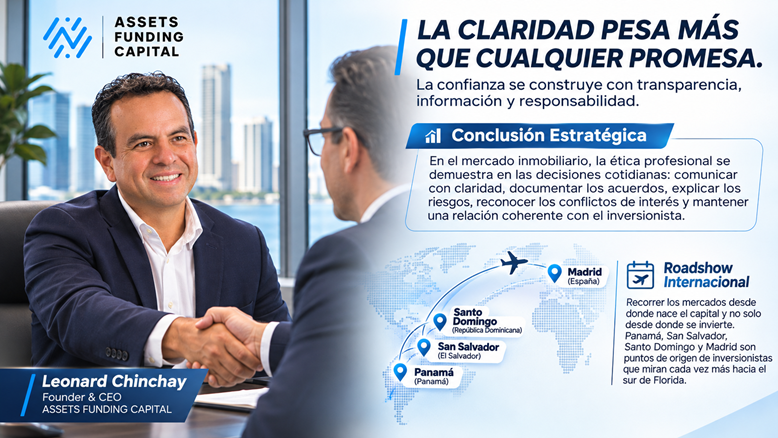
In the real estate market, professional ethics is demonstrated in everyday decisions: communicating clearly, documenting agreements, explaining risks, recognizing conflicts of interest, and maintaining a coherent relationship with the investor.
For those who participate in Florida projects from the United States or from other countries, these criteria take on special value. Distance should not prevent understanding how an opportunity is structured, who is involved in it, and what are the conditions that accompany the investment.
Confidence does not come from a sales pitch. It is built through consistent practices, understandable information, and professional responsibility.
At Assets Funding Capital, we are much more than an investment firm. Our approach is based on strategic knowledge, accompaniment, and a relationship with the investor based on information and analysis.
Learn more about our approach to real estate investing: